
A Simple Step-by-Step Way to Help.
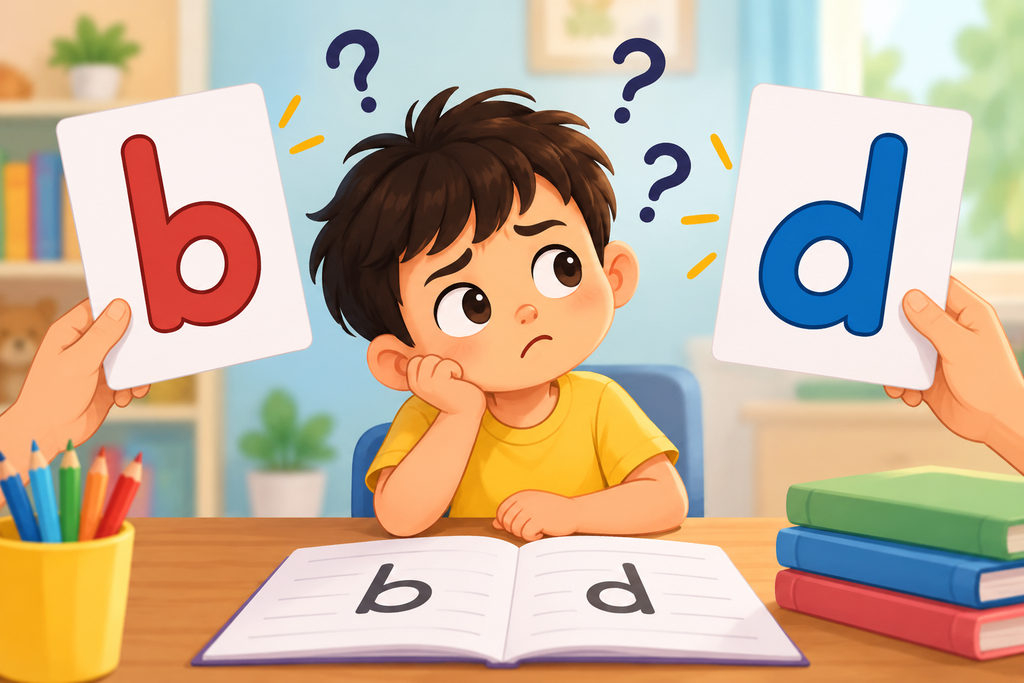
Why Does My Child Confuse b and d?
“My child keeps confusing b and d.”
This is something many parents notice when their child starts learning to read and write.
You may see your child:
- read b as d
- write d instead of b
- confuse p and q
- recognise the letter correctly one day and make a mistake the next day
So, the first question parents usually ask is:
“Is this normal?”
Is b and d Confusion Common?
Yes, b and d confusion is quite common in young children, especially in the early years of learning to read and write.
The letters b and d look very similar. The main difference is the direction of the round part.
A young child is still learning to notice these small differences quickly.
The child also has to remember:
What the letter looks like
What sound it makes
How to write it
How to recognise it inside a word
So, making an occasional b/d mistake does not mean that your child has a learning problem.
What is more important is to see whether the child is improving with practice and support.
So, How Can We Help?
Instead of correcting the child again and again by saying,
“This is b!”
“No, this is d!”
we can give the child some simple memory tricks and activities.
Here are three techniques that you can try.
Technique 1: The Left Hand – Right Hand Trick
This is one of my favourite activities for helping children remember b and d.
What do you need?
- 2 A4 sheets
- A marker or pencil
- Small pieces of paper or sticky notes
Step 1: Make Two Big Letters
Take one A4 sheet and write a big lowercase b.
Take another A4 sheet and write a big lowercase d.
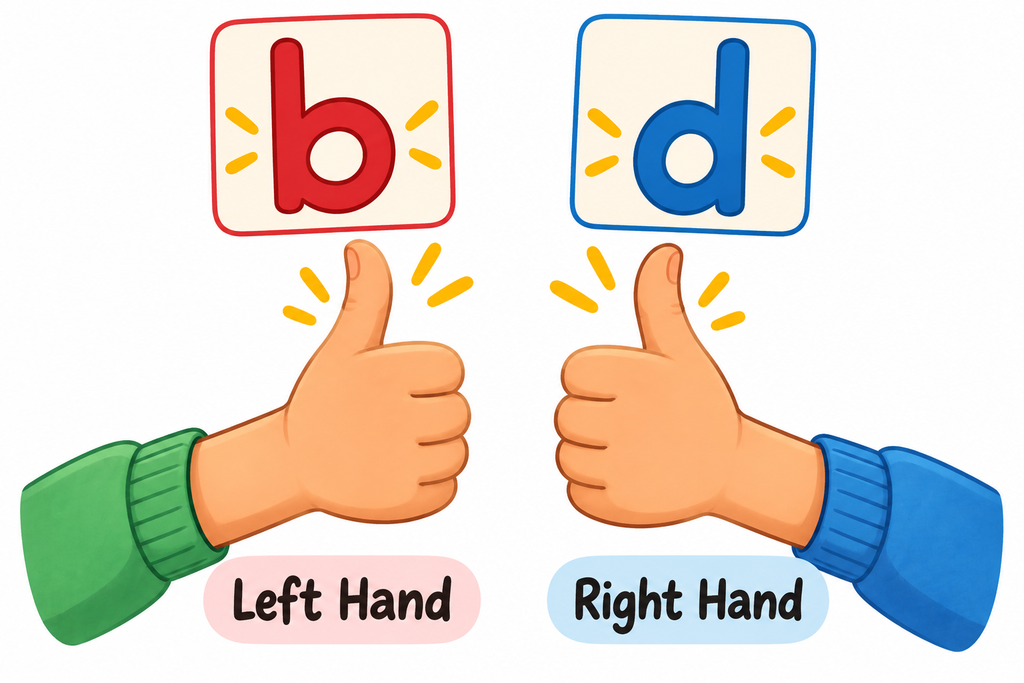
Now ask your child to put both hands up with their thumbs pointing upwards.
Place the left hand on the big b.
Say:
“Left hand is b.”
Now place the right hand on the big d.
Say:
“Right hand is d.”
Let the child look at the shape.
Don’t just tell the child.
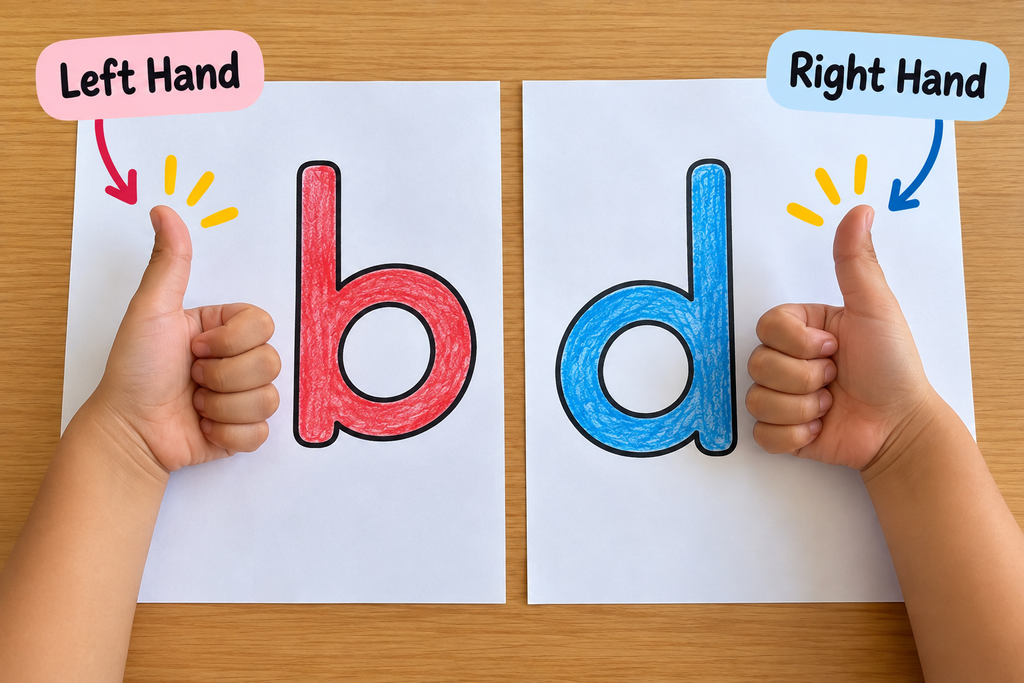
Let the child see it. Let the child do it. Let the child say it.
Practise:
Left → b → /b/
Right → d → /d/
Repeat this several times.
Step 2: Practise b Separately
Once the child understands b, start with only b words.
Write words on small pieces of paper or sticky notes.
For example:
bat
bag
bed
big
bus
Place one word at a time.
Ask the child to read it.
Remind them:
“Look at the first letter. Is it b?”
Then say the sound:
b → /b/
Then read the word:
bat
Don’t mix b and d yet.
Give the child enough practice with b first.
Step 3: Practise d Separately
Now do the same thing with d.
Use simple words such as:
dog
dot
dig
dad
duck
Again, practise d separately.
d → /d/
Then read the word.
This gives the child confidence with each letter before we ask them to tell the difference between the two.
Step 4: Now Mix b and d
Once the child is comfortable with both letters, mix the words.
For example:
bat
dog
bag
dig
bed
dot
Ask the child:
“Read this word.”
The child now has to look carefully at the first letter.
You can also say:
“Find a b word.”
“Now find a d word.”
Step 5: Try Words With b and d in Different Positions
Now make it a little more challenging.
Try simple words such as:
bad
dab
bud
dub
This is a great way to make the child look carefully at the letters.
For example:
bad → dab
The child needs to notice that changing the position of b and d changes the word.
You can also try:
bud → dub
Keep it playful.
The goal is not to test the child.
The goal is to help the child notice the difference.
Technique 2: “b Has a Belly, d Has a Diaper”
Children often remember funny and simple ideas very well.
So try this:
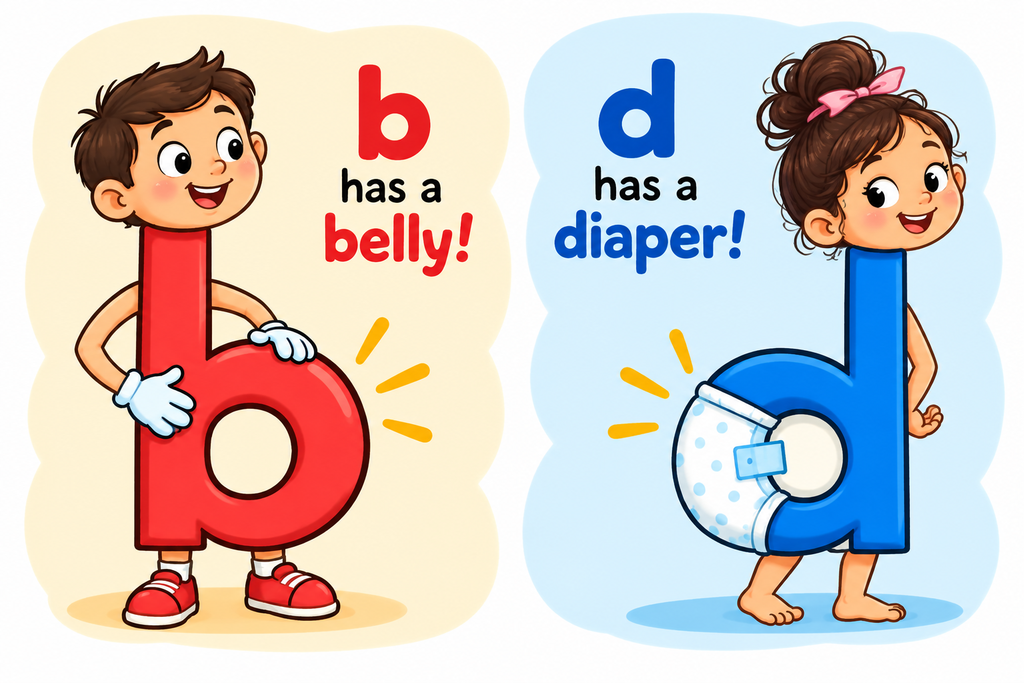
b has a belly!
Look at the round part of b.
It looks like a little belly.
Ask:
“Where is b’s belly?”
Let the child point to it.
Then:
d has a diaper!
Ask:
“Where is d’s diaper?”
Let the child point to the round part.
You can make this into a little game.
Show the child:
b
Ask:
“Belly or diaper?”
Child:
“Belly!”
Show:
d
Child:
“Diaper!”
Then connect it to the sound:
b → belly → /b/
d → diaper → /d/
The sillier and more memorable it is, the more likely the child is to remember it.
Technique 3: The BED Trick

Here is another simple way to remember b and d.
Write:
b e d
Then draw a simple bed underneath.
Tell your child:
“b and d sleep in a BED!”
The b is at one end.
The d is at the other end.
Let the child write:
b e d
and draw a little bed.
Then play a small game.
Cover the b.
Ask:
“Which letter is missing?”
Cover the d.
Ask:
“Which letter is missing?”
You can also say:
“Who is sleeping on the left side?”
“Who is sleeping on the right side?”
This gives the child another memory connection.
Don’t Forget Multisensory Practice
Sometimes children need more than just looking at the letters.
Let them:
Trace the letters in sand
b → /b/
d → /d/
Make the letters with play dough
Let the child build the letter while saying its sound.
Write the letters in the air
Use a big arm movement.
“Make a big b!”
“Now make a big d!”
Finger trace
Let the child trace the letter with a finger while saying the sound.
The idea is simple:
See it.
Say it.
Touch it.
Move it.
Write it.
Using more than one sense can make the learning experience stronger and more memorable.
One Important Rule: Don’t Mix Too Early
If your child is still struggling with b, don’t immediately give them:
b d b d b d
First make sure the child is comfortable with b.
Then practise d.
Then compare them.
Then use them in words.
Think of it as:
b → b words → d → d words → b & d together → mixed words
Give the child time to succeed at each step.
What If My Child Still Keeps Confusing Them?
Be patient.
Don’t say:
“You already learned this!”
Instead say:
“Let’s check again.”
“Which hand is b?”
“What sound does b make?”
Give the child a chance to use the memory technique.
The aim is to help the child find the answer, not simply give the answer every time.
When Should Parents Be More Concerned?
Occasional b/d reversals are common in young children.
But if your child continues to have many difficulties with letters and sounds, or also struggles with:
- remembering letter sounds
- recognising many letters
- blending sounds
- reading simple words
- spelling simple words
- making progress even after regular practice
then it is a good idea to speak with the child’s teacher or a qualified learning professional.
Don’t look at one mistake.
Look at the child’s overall reading development.
Remember, Don’t Panic!
If your child writes d instead of b, don’t immediately worry.
Instead, ask:
“What does my child need help remembering?”
Give the child a simple memory clue.
Give them practice.
Use movement.
Use sounds.
Use words.
And most importantly, keep the practice positive and fun.
Because sometimes a small memory trick can make a big difference.
b is b.
d is d.
And with the right practice, your child can learn to tell them apart with confidence.